There is much creative about the critical process, and there is much critical about the creative one. (Just to be clear, ‘critical’ here means inquiry, not condemnation.)
I’ve lived my life between the two. My education was standard British post-war poor middle class (my dad was a C of E priest), and I hit the drugs sex and rock’n’roll revolution of the late 60s/early 70s at just the right time.
A Cambridge degree in History (scraped in by the skin a me teeth, I applied to do English, they said No but you can do History) taught me … what?
Information management and the critical appraisal of sources. What could I do with that? Teach history? Nah. Solicitor, accountant (nah, I was – still am – innumerate), something in the Civil Service? Nah, nah and nah again.
My early 70s Cambridge graduate contemporaries wanted to cast themselves in a non-privileged non-intellectual mould. Guilt? I dunno, don’t really care. I do know that in the post-uni years of my early 20s in 70s London, after the miserably failed attempt at mounting the public service ladder – in this case social work – I was lying in my attic bedroom staring at the wooden window surround set into the roof at its natural angle, thinking: ‘Fuck yeah. I wanna work with wood.’
…
… so I did. It wasn’t easy. I was 23, way too old for an apprenticeship, which anyway in those days lasted seven years, the first three of which you spent sweeping up and making tea and being sent to the hardware store for a pound of rubber nails. My miserable failure as a social worker in Mitcham, a depressed, depressing and depressive semi-suburban outlying district of south-east London, had come to an end when I decided that for my ‘clients’, as they were called, to occupy my dreams and nightmares was not a recipe for professional fulfilment. One woman still haunts me; her whole life, and that of her 4-year old son and 2-year old daughter, revolved around doctors, hospitals and sickness. The 4-year old had been in hospital 13 times in his short life when I met them. Not a scenario for an optimistic and cheerful over-educated youth to be remotely optimistic about contributing to societal change.
Foundation retrofit on a Maine island
What did I know about woodwork? How to do a half-lap joint, sometimes known as a lap joint, learnt in school woodwork lessons. Not much more than that. Where and how could I find someone willing to take me on in some sort of training, or even pay me to stick bits of wood together? The revelation was the wooden window surround moment, but I had been ‘warmed up’ handling tools and materials the previous summer, when I had wangled a job digging a cellar under a 17th-century wooden house on the island of Monhegan, Maine, where the (then) love of my life had a summer gig at The Island Inn, which could easily have been the template for the Hotel New Hampshire.


Said house had been built on a series of massive granite blocks, 10 feet long by 18 inches square, and after 300 years they were sliding down the hill and taking the house with them. So Harry the alcoholic householder (pretty much everyone on that island was alcoholic) had decided to get a cellar dug out and concrete foundations put in, the wet cement poured into wooden-walled ‘shuttering’ which butted up to the under frames of the house itself. It was muggins’ job – along with lazy good for nothing shirking Danny, who spent more time and energy avoiding work than actually working – to dig out enough space and then construct this shuttering. Hey presto, stick bits of wood together and you get a proper foundation after the fact.
Gentle Ghost
Which, I suppose, was where it started. But back in London? I read a piece in Time Out, the hip listings weekly of the time, about Gentle Ghost, a random collection of middle class wannabe craftspeople. Their attraction was solely that they didn’t strike the fear of hairy-arsed builders into the hearts of genteel west London home improvers. Gentle Ghost, basically a hippy employment agency, sent untrained, unskilled and inexperienced carpenters, plumbers, electricians and what not into the homes of the clientele aforesaid, where they created a variety of disasters and some occasionally useful outcomes, much to the pleasure of clients who preferred a middle class accent to reliable tradecraft in their tradespeople. ‘But I haven’t been trained or anything,’ I said to the two masterminds of this grotesquely irresponsible enterprise. ‘No worries’, they said. ‘We had a guy last week asking the woman in the house where he was working if he could borrow her shoe to hammer a nail in.’
And thus began my introduction to responsible craft. I cared about doing it right, which is always a good start; but without having so much as read a book or an article about how to fashion and erect a kitchen cupboard, my first few jobs were all ghastly cock-ups – nonetheless appreciated, even admired, by the unfortunate householders to whom ‘working with your hands’ was an impenetrable mystery.
First job: kitchen cupboard, which as far as I recall gave on to a wooden worktop, all framed up with half-lap joints in 2×1 (basic 50x25mm softwood framing timber) and clad with 5/8in (9mm) ply. Not at all the technique of choice, I was soon to discover. Took me three attempts to realize (Chagrin #1) that drilling into a wall with a hand drill was a definite non starter. The damn thing just didn’t go fast enough to drill proper holes; it just sort of ate away at cavities of ever-increasing size.
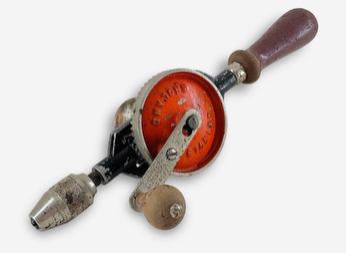
Vintage hand drill. Might be Stanley, might be Record, two renowned Sheffield brands
First stop on the way in for Day Two; the tool store, where I bought the Wolf electric drill I still have.
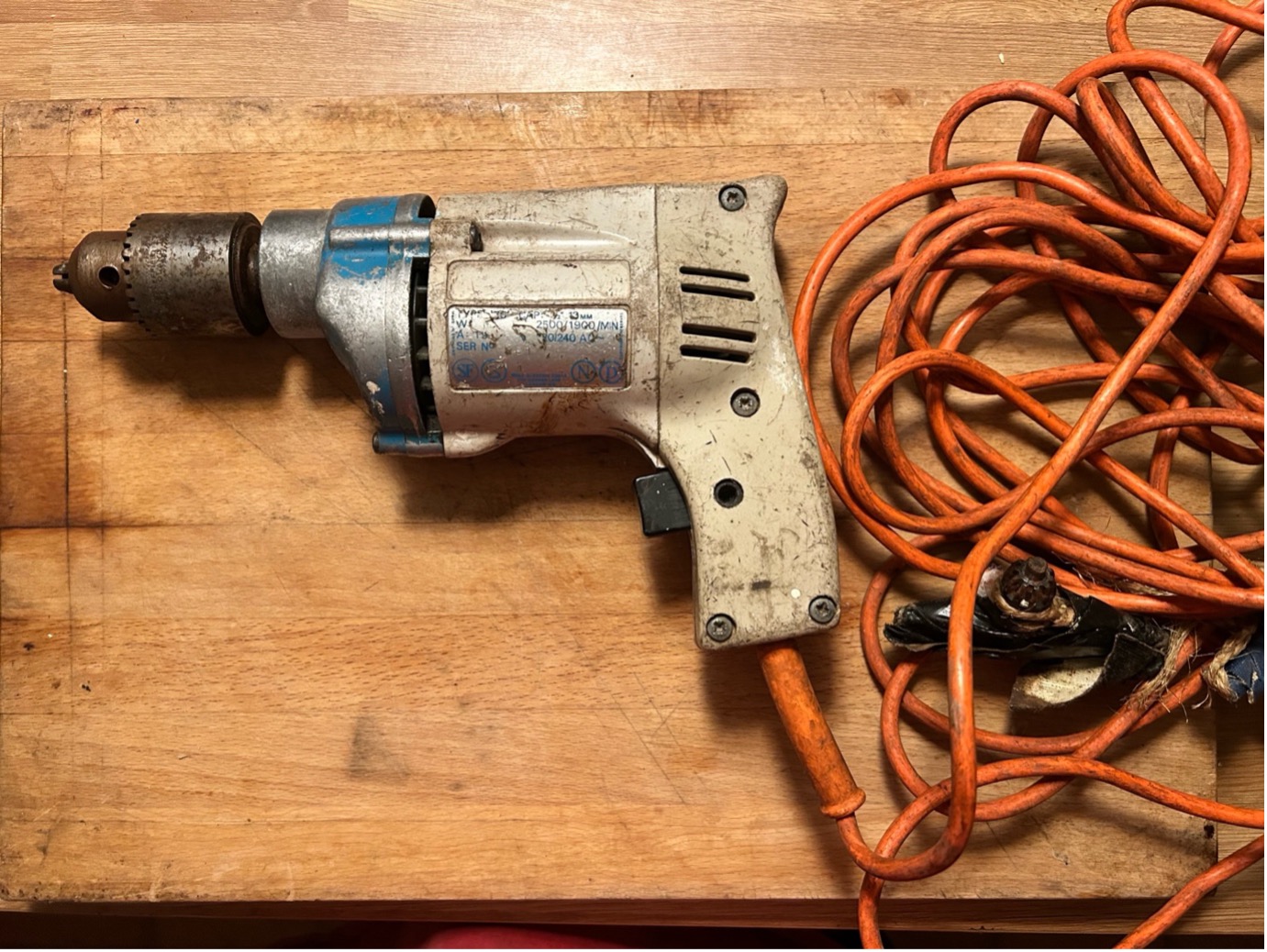
Wolf drill with much after-market cable fitted so I didn’t have to faff with extension leads. It’s all cordless now of course.
Chagrin #2: leaving the too-long hinge screws poking out through the front of the too-thin cupboard door and hastily acquiring a file on the way into the job on Day Three to flatten them off. Clients still not only satisfied but pleased.
The Case for Working with Your Hands
That thing about not reading a book or article; my profoundly misguided conviction was that since I had spent my life so far in ‘book learning’, now was the time to learn by doing. Inexplicably, I eschewed all forms of educational literature on the subject of woodworking, determined to learn by my mistakes – of which there were many, and many of them spectacular. I can’t quite believe I wasn’t sued to high heaven for – for instance – creating an expensive pair of figured maple veneered shelving units, complete with arched tops and ebony inlay, to fit into chimney alcoves in an elegant Holland Park house. For the actual shelves I used chipboard, known in the trade as ‘weetabix board’, which has almost no structural rigidity and which began to exhibit severe downward bowing as soon as books and precious ornaments were placed on them. Even now the cold fingers of Chagrin #43 creep up and down my back.
Many years later I came upon The Case for Working with Your Hands (originally published in the US as ‘Shop Class as Soulcraft: An Inquiry in the Value of Work’) by Matthew Crawford, a political philosopher and motorcycle engineer. In far more erudite, elegant and comprehensible language than I could ever concoct, and without subscribing to the proto-spiritual effect of handwork that William Morris and John Ruskin promoted through the Arts and Crafts movement, he makes the persuasive case that, simply, working with your hands is good for you – good for the soul – in a way that office or ‘knowledge’ work is not. ‘This book grows out of an attempt to understand the greater sense of agency and competence I have always felt doing manual work, compared to other jobs that were officially recognized as “knowledge work,”’ he says. ‘Perhaps most surprisingly, I often find manual work more engaging intellectually. This book is an attempt to understand why this should be so.’
At the time I was screwing up the hinges of a badly built cupboard or choosing woefully inappropriate materials for the task at hand, I didn’t give any of this kind of stuff a thought. I just took the financial hit, went back and did it again, and maybe – just maybe – looked something up. I self deprecatingly describe this period as taking ten years to learn what I could have done in two if I’d only opened a book; but I did end up with a high level of skill, and a deep sense of satisfaction at completing, for instance, a massively complicated 6-meter (20ft) long by 3-meter (10ft) high bookshelf-console combination to an overall accuracy of 2mm, or the curved, panelled and glazed oak entranceway to the Rubens Hotel in central London. It’s still there, more than 40 years later.

Neither job, I hasten to point out, was done by me and me alone; my crew was almost always willing and usually able.
The Dignity of Craft I wasn’t much acquainted with the work of William Morris aforesaid, the middle class furniture designer and typoghrapher who is credited with founding the Arts and Crafts movement – Charles Stewart Parnell and the Irish Home Rule party from 1880 – 1886 was more my speciality. But I was fortunate enough to be exposed to some true craftspeople, not so much of the ‘Middle Class Designer Maker’ variety – that came later – but people such as George Thompson, a ‘second fix’ carpenter I worked with on a house conversion in Fulham, south-west London. (First fix was the rough building stuff, beams and joists and roof timbers; second fix was more highly skilled, interior work, things like installing skirting, hanging doors and fitting cupboards.)
George came to work on what was essentially a building site wearing a trilby hat and smart Burberry-style overcoat, with highly polished brown shoes, carrying a pair of exquisitely crafted wooden briefcases – maple, mahogany, ebony inlays, concealed dovetails, things of beauty – which were his toolchests. They couldn’t accommodate his handsaw, so he carried that under his arm wrapped in brown paper.
George taught me that a broom was one of the trade’s (we didn’t say ‘craft’) most important tools; ‘Sweep up every 15 minutes’. A marked and rather pathetic contrast to the malodorous Michael O’Leary, another carpenter on the same job, whose modus operandi consisted of shuffling around in piles of shavings, crisp packets, Coke bottles and sawdust, looking for screws, hinges or hand tools he had dropped or lost after a four-pints-of-Guinness lunch hour in the pub.
George taught me that no floor, wall, ceiling or other surface in any house, new or old, was ‘true’ – ie it was never 100% upright, 100% flat or at 100% right angles with its neighbour. Hence the craft of ‘scribing’, which is using a small block the width of the gap you have to close – he used a compass from a school geometry set – to carry a pencil with which you mark the inconsistent line between, for example, wall and edge of ‘workpiece’, so that when cut along that shaky line, the workpiece fits snugly.
But what he really taught me, and it abides to this day, is respect. Respect for tools, for materials, for the process, and, by implication, for the client. This is where a man who left school at 15 and had no ambition or aptitude for ‘book learning’ would fit right in with William Morris.
Yes, but what about the critical / creative / constructive thing? ‘Going and growing from a critical to a creative self (via construction)’ means that I never saw my self as creative. Constructive, yes; and even when I started editing magazines – the critical process – I saw it as constructive. ‘Creative’ came later. Much later…
To be continued….

